
Allopurinol
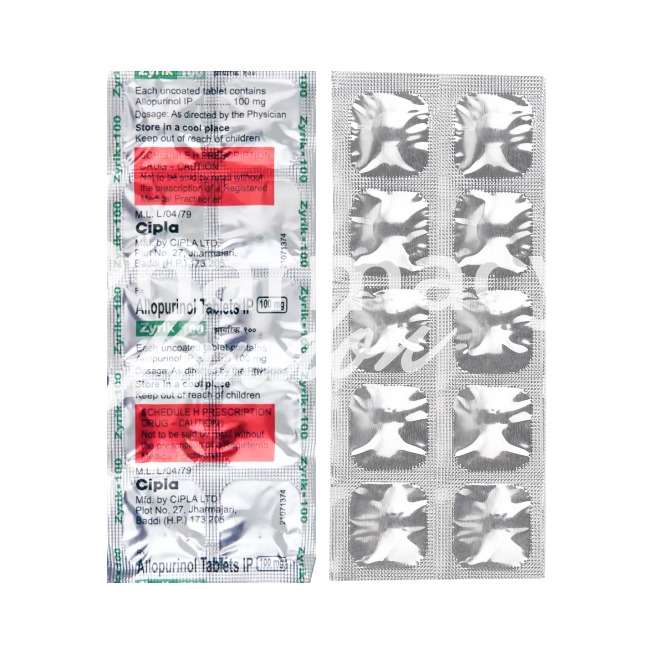
In stock
300mg
from 28,19 £
In brief
- Allopurinol is a prescription-only medicine in the UK because of the risk of serious side effects.
- Allopurinol is used to lower uric acid in conditions such as gout (chronic hyperuricaemia), prevention of uric acid kidney stones and prophylaxis of tumour lysis syndrome; it is a xanthine oxidase inhibitor that reduces uric acid synthesis.
- Typical adult dosing starts at 100 mg once daily and is titrated by serum uric acid; usual maintenance is 200–300 mg/day for mild disease and 400–600 mg/day for more severe cases, with doses up to 800 mg/day in specialist-managed situations; dose reductions are required in renal impairment; children (when indicated) typically 10–20 mg/kg/day, max ~400 mg/day.
- Allopurinol is administered orally, most commonly as film‑coated tablets (standard strengths 100 mg and 300 mg).
- Allopurinol begins to lower serum uric acid within about 24–72 hours, but clinical improvement (fewer flares, reduction of tophi) may take several weeks to months; it should not be started during an acute gout flare.
- The pharmacological effect is sustained with daily dosing—the active metabolite oxypurinol prolongs activity so once‑daily dosing is common and effect on urate levels is maintained over 24 hours; long‑term therapy is often required for chronic conditions.
- Avoid excessive alcohol while taking allopurinol as alcohol can raise uric acid levels and precipitate gout flares; discuss alcohol use with your prescriber, especially with liver disease or when taking other interacting medicines.
- The most common side effect is skin rash (which can herald severe hypersensitivity and requires immediate stopping and medical review); other frequent effects include gastrointestinal upset (nausea, diarrhoea), headache and mild liver enzyme elevations.
- Would you like to try allopurinol without a prescription?
Basic allopurinol information
-
INN (International Nonproprietary Name): Allopurinol.Also referenced as Allopurinolum or Allopurinolum Ph. Eur.
-
Brand names available in the United Kingdom: allopurinol supplied by Teva, Sandoz, Mylan, Accord and Zentiva, and the originator brand Zyloric.Typical package forms: film-coated tablets in blister packs, commonly 100 mg and 300 mg strengths.
-
ATC code: M04AA01.Classified under antigout preparations inhibiting uric acid production.
-
Forms and strengths: standard oral tablets 100 mg and 300 mg are most common.
-
Manufacturers in the United Kingdom: major suppliers include Teva, Sandoz, Mylan, Accord, Zentiva and Sanofi (Zyloric).
-
Registration status in the United Kingdom: licensed by the MHRA; prescription‑only medicine.Included on national and international essential medicines lists.
-
OTC / Rx classification: Prescription‑only (Rx) in the United Kingdom.Prescribing and monitoring are necessary because of risk of serious adverse reactions.
Legal status and availability in the UK
In our online pharmacy, allopurinol is available without a prescription, with discreet delivery to the United Kingdom in 9–21 days.
Clinical effectiveness in the UK
People want to know when they will feel better and what the NHS sees in routine practice.
Allopurinol reduces gout flare frequency, decreases tophi formation and lowers the incidence of uric‑acid kidney stones when serum urate is maintained below targets.
Most measurable clinical benefit in NHS practice appears after three to six months of consistent, titrated therapy.
Common patient complaints include gastrointestinal upset, skin rash and a temporary increase in flare frequency shortly after initiation.
Common challenges include under‑titration, intermittent monitoring of serum urate and renal function, and inconsistent use of prophylaxis (colchicine or NSAID) when starting therapy.
-
Expected outcomes:- Reduction in flare frequency.- Decrease in tophi size over months to years.- Lower rate of uric‑acid kidney stone events.
| Time to response | Typical observation |
|---|---|
| 0–4 weeks | Possible initial flares; prophylaxis recommended when starting |
| 3–6 months | Clear serum urate reduction and fewer flares for many patients |
| 6–12 months | Tophi regression and sustained clinical benefit with target maintenance |
Practical tip: starting at 100 mg/day with titration to 200–300 mg/day for many patients is common in primary care, with maintenance often between 200–600 mg/day while monitoring renal and liver function.
Indications and expanded uses (MHRA‑approved and off‑label)
Patients ask what allopurinol is approved for and where clinicians might use it off‑label.
MHRA‑approved indications include chronic gout with hyperuricaemia, prevention of uric‑acid nephrolithiasis and prophylaxis of tumour‑lysis syndrome under oncology protocols.
Off‑label uses in UK practice, under specialist supervision, include management of recurrent uric acid stones without clear hyperuricaemia and long‑term lowering therapy for rare inherited purine disorders.
Allopurinol is not started during an acute gout flare because initiation can exacerbate symptoms in the short term.
| Indication | Starting dose | Maintenance / short‑course note |
|---|---|---|
| Chronic gout (hyperuricaemia) | 100 mg/day, titrate up | Maintenance typically 200–600 mg/day; titrate to serum urate <360 µmol/L |
| Uric‑acid kidney stones | As per gout initiation | Lower maintenance as clinically required |
| Tumour‑lysis syndrome prophylaxis | 600–800 mg/day in divided doses | Short‑term high dose under oncology protocols |
| Selected off‑label uses | Specialist dosing (case‑by‑case) | Used under specialist supervision for rare metabolic disorders |
Note: Allopurinol is prescription‑only and is used for prevention rather than relief of acute gout pain.
Composition and brand landscape
Patients often ask whether to choose a brand or a generic.
The active ingredient is allopurinol (INN), a xanthine oxidase inhibitor that reduces uric acid synthesis.
The ATC code is M04AA01, placing it among preparations that inhibit uric acid production.
In the UK market most products appear as generics from Teva, Sandoz, Mylan, Accord and Zentiva, alongside Sanofi’s Zyloric brand.
| Supplier | Typical pack sizes | Point of sale |
|---|---|---|
| Teva, Sandoz, Mylan, Accord, Zentiva | Blister packs of 28, 56 or 84 tablets commonly in 100 mg and 300 mg | Community pharmacy, NHS prescription, hospital supply |
| Sanofi (Zyloric) | Blister packs 100 mg and 300 mg | NHS and private prescription |
Regulatory note: allopurinol is MHRA‑approved and prescription‑only.
Contraindications and special precautions (high‑risk groups)
Patients worry about rashes and rarer severe reactions; these need clear counselling.
Absolute contraindications include prior hypersensitivity to allopurinol or excipients and a history of severe cutaneous adverse reactions such as Stevens–Johnson syndrome or toxic epidermal necrolysis.
Special precautions apply in renal or hepatic impairment, where dose reductions and slower titration are advised.
Elderly patients should start at the lowest effective dose.
Testing for HLA‑B*5801 should be considered in higher‑risk ethnicities, including some South Asian and East Asian groups.
Pregnancy and breastfeeding are relative precautions; use only if essential and under specialist review.
-
Key contraindications:- Known hypersensitivity to allopurinol or excipients.- Prior SCARs (Stevens–Johnson syndrome/TEN).- Initiation during an acute gout attack.
Action if rash appears: stop immediately and seek urgent medical review because rashes can herald severe reactions.
Yellow Card reporting: suspected adverse reactions should be reported to the MHRA Yellow Card scheme.
Dosage guidelines (standard NHS regimens and special populations)
One of the most common questions is "how should I be started and how quickly will the dose change?".
Standard adult initiation in primary care is 100 mg once daily, with some clinicians starting 50 mg in severe renal impairment.
Titrate by roughly 100 mg every two to four weeks until serum urate is below 360 µmol/L.
Typical maintenance is 200–300 mg/day for mild cases and 400–600 mg/day for more severe hyperuricaemia.
Specialist centres may use up to 800 mg/day in selected patients.
In renal impairment dose reduction is necessary; an example is that when creatinine clearance falls below 20 mL/min many sources recommend a maximum near 100 mg/day and specialist review.
Children receive allopurinol only for chemotherapy‑related hyperuricaemia or rare inherited disorders, typically 10–20 mg/kg/day in divided doses up to 400 mg/day.
| Indication | Start | Titration | Max | Monitoring frequency |
|---|---|---|---|---|
| Chronic gout | 100 mg/day | Increase by 100 mg every 2–4 weeks to target | Up to 800 mg/day (specialist) | Serum urate and renal/liver tests every 2–6 months during titration |
| Renal impairment | 50–100 mg/day depending on severity | Slower titration with specialist input | Often limited to ~100 mg/day if CrCl <20 mL/min | Frequent renal monitoring and specialist review |
| Tumour‑lysis prophylaxis | 600–800 mg/day divided | Per oncology protocol | Short‑term high dosing | Daily monitoring in hospital settings |
Interactions overview (drugs, food, Yellow Card reports)
Patients frequently ask which medicines should not be taken with allopurinol.
The most important drug interactions occur with azathioprine and mercaptopurine because xanthine oxidase inhibition increases thiopurine levels and can cause bone‑marrow suppression.
If these are co‑prescribed, thiopurine doses must be substantially reduced and carefully monitored by a specialist.
Concurrent use with warfarin may require closer INR monitoring.
Reports associate increased rates of skin rash when amoxicillin or ampicillin are given concurrently, so prescribers remain cautious.
Febuxostat co‑prescription is uncommon and generally managed by specialists.
Alcohol and high‑purine diets raise urate and can blunt the clinical response to therapy.
Reported adverse reactions include skin reactions, hepatic enzyme rises and rare severe outcomes; suspected adverse reactions should be reported via the Yellow Card scheme.
Comparable medicines and prescribing preferences
When allopurinol is unsuitable, clinicians consider alternatives but weigh pros and cons carefully.
Febuxostat is the principal xanthine‑oxidase alternative on the NHS and is used particularly where allopurinol intolerance exists.
Uricosuric drugs are specialist second‑line options and require adequate renal function to be effective.
Rasburicase is reserved for tumour‑lysis scenarios where rapid urate breakdown is required and is used in hospital or oncology settings.
-
Allopurinol — Pros: long safety record; Cons: SCAR risk and renal dosing considerations.
-
Febuxostat — Pros: alternative for intolerance; Cons: cardiovascular safety discussions require case‑by‑case use.
The NHS tends to favour allopurinol first‑line for its long experience and effectiveness, reserving alternatives for intolerance or specialist indications.
Frequently asked questions
-
Can I start allopurinol during a gout flare?No.Initiation during an acute flare can worsen symptoms in the short term; wait until the flare resolves and provide prophylaxis (colchicine or NSAID) when starting.
-
How long until allopurinol works?You should see urate lowering and fewer flares over three to six months with correct titration to target.
-
What monitoring is needed?Baseline and periodic serum urate, renal and liver tests are required.Frequency depends on stability but is often every 2–6 months during titration and 6–12 monthly once stable.
-
What if I get a rash?Stop allopurinol immediately and seek urgent clinical review because rashes can herald SCARs.
-
Where can I find reliable patient information?See the NHS gout pages for patient leaflets and the MHRA Yellow Card site for reporting suspected side effects.
Guidelines for proper use (pharmacist counselling and NHS support)
Pharmacist counselling makes a difference to safety and adherence.
Counselling should explain the purpose (urate lowering), the dosing plan and titration schedule and the expected timeframe of three to six months for benefit.
Pharmacists must underline the importance of blood tests, common side‑effects and urgent signs such as rash and fever.
Interaction warnings should be highlighted, especially with azathioprine and mercaptopurine.
Advice on alcohol moderation, hydration and diet should be provided alongside guidance about missed doses.
-
Pharmacist counselling checklist:- Explain start dose and titration steps.- Outline monitoring schedule for serum urate, renal and liver tests.- Discuss common side‑effects and emergency signs (rash, fever).- Review drug interactions, especially thiopurines and warfarin.- Signpost to NHS 111, GP or rheumatology and to Yellow Card reporting.
Action steps:
- Rash: stop drug and seek immediate medical review.
- Missed dose: take when remembered unless close to the next dose; do not double up.
- Overdose: seek emergency care immediately.
Delivery across the United Kingdom
| City | Region | Delivery Time |
|---|---|---|
| London | England | 9–21 days |
| Birmingham | England | 9–21 days |
| Manchester | England | 9–21 days |
| Glasgow | Scotland | 9–21 days |
| Leeds | England | 9–21 days |
| Liverpool | England | 9–21 days |
| Bristol | England | 9–21 days |
| Newcastle Upon Tyne | England | 9–21 days |
| Sheffield | England | 9–21 days |
| Edinburgh | Scotland | 9–21 days |
| Cardiff | Wales | 9–21 days |
| Belfast | Northern Ireland | 9–21 days |
| Norwich | England | 9–21 days |



