
Meclizine
In brief
- Meclozine (meclizine) travel sickness tablets are pharmacy (P) medicines in the UK and are available from pharmacies without a prescription.
- Meclizine is used to prevent and treat motion sickness and to relieve vertigo or dizziness. It is a first-generation antihistamine with anticholinergic effects that helps reduce signals from the inner ear to the brain.
- The usual adult dose is 25–50 mg taken about 1 hour before travel for motion sickness, or 25–100 mg daily in divided doses for vertigo. Do not exceed 100 mg per day unless advised by a clinician.
- It is usually taken as a tablet or chewable tablet by mouth.
- It usually starts working within about 1 hour after taking it.
- The effects generally last around 24 hours, which is why it is commonly taken once daily for motion sickness prevention.
- Alcohol should be avoided, as it can increase drowsiness and other central nervous system depressant effects.
- The most common side effect is drowsiness; other common effects include dry mouth, blurred vision and fatigue.
- Would you like to try meclizine without a prescription?
Legal status in the UK
Meclozine travel sickness tablets are pharmacy (P) medicines in the UK and are available from pharmacies without a prescription.
Basic meclizine information
- INN (international nonproprietary name): Meclozine (meclizine).
- Brand names available in the United Kingdom: Meclozine.
- ATC code: R06AE05.
- Forms and dosages: tablet, chewable tablet.
- Manufacturers: multiple generic manufacturers.
- OTC / Rx classification: pharmacy (P) medicine in the UK.
Clinical effectiveness in the United Kingdom
Patients usually want to know one thing first: will it actually help before a ferry crossing, coach trip, or spell of spinning vertigo?
Meclizine is mainly used for motion sickness prevention and for symptom control in some types of vertigo, but the response depends on the cause.
In UK practice, pharmacists often explain that it can work well when taken early enough, but it may also cause drowsiness, so it is not a medicine to test for the first time right before a long drive.
| What may improve | What may not improve | How quickly people notice effects |
|---|---|---|
| Travel nausea, spinning sensation, and some dizziness | All causes of dizziness, severe vomiting, or structural ear problems | Usually within about 1 hour for travel use |
- Adult travel dose: 25–50 mg one hour before travel, with repeat dosing every 24 hours if needed.
- Adult vertigo dose: 25–100 mg daily in divided doses, with a maximum of 100 mg daily.
- Onset matters: it works best when timed properly before the journey.
- Short term use is typical: many people only need it for a trip or a brief period of vertigo symptoms.
- Get checked urgently if dizziness comes with unilateral hearing loss, neurological symptoms, or severe vomiting.
Indications and expanded uses in the NHS
- Motion sickness
- Used to help prevent travel sickness on journeys by car, coach, ferry, plane, or cruise.
- Vertigo
- Used for symptom relief where an antihistamine is considered appropriate for vestibular symptoms.
- Off-label
- Use outside the exact wording of a local licence, often where clinicians judge the benefit to outweigh the risk.
In the NHS and private sector, clinicians sometimes use antihistamines for vestibular symptoms when other options are unavailable or not well tolerated.
Travel clinics, GP services, and community pharmacists may recommend it when the problem is clearly motion-related and the person has used similar products before.
If the dizziness sounds unusual, keeps returning, or does not fit a travel or vestibular pattern, a different diagnosis should be considered rather than reaching for anti-sickness pills.
Composition and brand landscape
In the UK the medicine is known as meclozine (meclizine in the United States).
| Name | Region | Usual strength | How patients may encounter it |
|---|---|---|---|
| Meclozine | United Kingdom | 25 mg | Community pharmacy or online pharmacy enquiries |
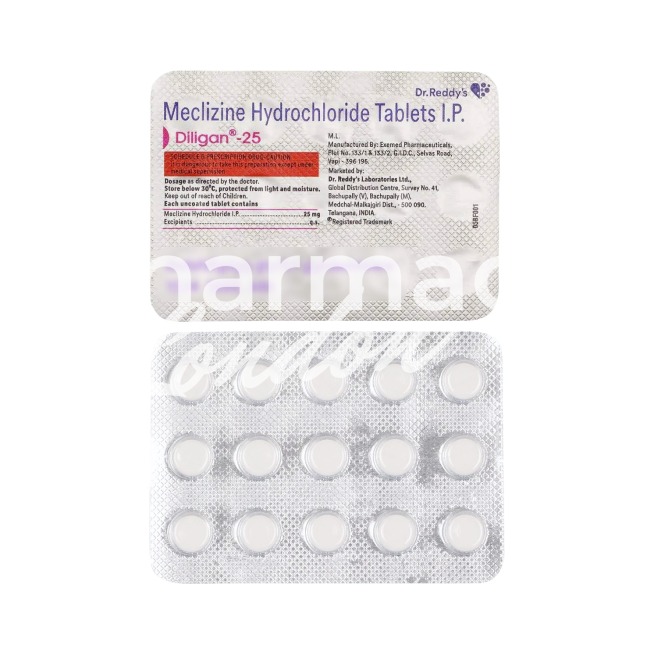
Packaging can look quite different between manufacturers even when the active ingredient is the same.
Contraindications and special precautions
Before taking meclozine, it helps to check the main risk factors first.
- Avoid meclizine if there is known hypersensitivity to meclizine, meclozine, or piperazine derivatives.
- Do not use in children under six because most products lack adequate safety data.
- Use caution in asthma.
- Use caution in angle-closure glaucoma.
- Use caution in prostatic hypertrophy and urinary retention.
- Start low in older adults because sedation and anticholinergic effects are more likely.
- Use caution in pregnancy and in severe liver or kidney impairment.
For day-to-day life, the biggest practical issue is usually drowsiness.
That matters if someone plans to drive, cycle, work on machinery, or care for an older relative after taking anti-sickness pills.
Alcohol can make the sedation worse, and falls risk is especially important in frail patients or anyone already on medicines that dry the mouth, slow the bowel, or make passing urine difficult.
In polypharmacy, anticholinergic effects can become much more noticeable, so a quick pharmacist check is worthwhile before using meclizine alongside other medicines.
Dosage guidelines and special populations
People usually want the straight answer on timing and dose, especially when a journey is booked and the coach leaves at seven in the morning.
| Group | Typical dose | Maximum daily dose | Practical note |
|---|---|---|---|
| Adults | 25–50 mg 1 hour before travel; 25–100 mg daily in divided doses for vertigo | 100 mg | Best taken before symptoms begin |
| Older adults | Start at the lower end, such as 12.5 mg | 100 mg | Higher risk of drowsiness and anticholinergic effects |
| Children under 12 | Limited safety data; some references suggest 12.5–25 mg once daily | Follow label or paediatric advice | Seek paediatric guidance first |
- Motion sickness prevention: take one tablet 1 hour before travel, then repeat once daily if needed.
- Vertigo regimens: doses may be divided through the day for several days if directed.
- Missed dose: take it when remembered unless the next dose is nearly due.
- Do not double up.
- Overdose signs: drowsiness, dry mouth, blurred vision, and rarely seizures; seek urgent help if these occur.
For ferries, flights, coaches, and long car journeys, pharmacists usually advise timing the dose so it has started working before the motion begins.
Interactions with other medicines and alcohol
Compared with some other anti-nausea tablets, meclizine usually has few major interactions, but it can still add to sedation.
| Substance or class | Expected effect | Practical advice |
|---|---|---|
| Alcohol | Increased drowsiness and poorer alertness | Avoid if possible |
| Sleeping tablets | More central nervous system depression | Use only with pharmacist or prescriber advice |
| Opioids | Greater sedation and slowed reaction time | Take extra care and check first |
| Benzodiazepines | More sleepiness and impaired coordination | Avoid unnecessary combination |
| Other antihistamines | More dry mouth, drowsiness, and confusion risk | Do not stack products without advice |
| Medicines that worsen dry mouth, constipation, or urinary retention | Anticholinergic effects may be amplified | Ask a pharmacist before combining |
Tea and coffee do not usually cause a major pharmacological interaction, although caffeine can upset some people’s stomachs or make palpitations more noticeable.
Any suspected problem with a medicine combination should be reported through the MHRA Yellow Card system.
How patients actually use it in the United Kingdom
In community pharmacy, the advice is usually practical and plain: take it early, watch for drowsiness, and do not mix it with alcohol or other sedating medicines without checking first.
In our online pharmacy, meclizine is available without a prescription, with discreet delivery to the United Kingdom in 9–21 days, which suits people who want to plan ahead for travel.
For dizziness that is not clearly travel-related, NHS 111 and NHS patient portals are often used to check whether the symptoms need a medical review rather than self-treatment.
Comparable medicines and patient preferences
Not every travel sickness tablet suits every person, and UK prescribers may suggest a different option depending on the symptom pattern.
- Cyclizine: often discussed for travel sickness and vertigo, with familiar UK use.
- Cinnarizine (Stugeron): commonly used for vertigo and motion sickness.
- Dimenhydrinate: related antihistamine with similar travel uses.
- Promethazine: effective for nausea and vertigo, but usually more sedating.
- Hyoscine (scopolamine) patch: useful for motion sickness prevention when a patch is preferred.
The key point is that the best choice depends on the problem.
Travel sickness, vestibular vertigo, and nausea from another cause are not interchangeable, and a medicine that helps one person may be too sedating or simply not the right fit for another.
Meclizine is often preferred by people who want a straightforward tablet option, but the sedation profile still needs respect, especially if work or driving is involved.
Common questions from patients
How long before travel should I take meclizine?
Take it about 1 hour before travel, and do not leave it until symptoms have already started if you can avoid that.
Can I drink alcohol with it?
It is best to avoid alcohol because it can increase drowsiness and make you feel more unsteady.
Is it suitable for older adults?
Yes, but start low and be cautious because older adults are more likely to get dry mouth, confusion, and sedation.
What if my dizziness does not improve?
Get medical advice, especially if there is hearing loss, vomiting that will not settle, or any unusual neurological symptom.
Guidance for safe use and pharmacy support
Safe use starts with timing, dose, and a simple plan for what to do if the medicine makes you sleepy.
- Store tablets at 20–25°C, in the original packaging, protected from moisture and light.
- Take the dose 1 hour before travel when using it for motion sickness.
- Use the lowest effective dose in older adults.
- Do not double a missed dose.
- If sedation occurs, avoid driving, cycling, alcohol, and other sedating medicines.
- Seek review if vertigo persists, worsens, or is linked with hearing loss or neurological symptoms.
Think of it as a simple three-step decision: take it at the right time, watch for drowsiness, and get checked if the symptoms do not fit routine travel sickness.
NHS 111, your GP, a community pharmacist, and NHS patient portals can all help if you are unsure whether meclizine is the right choice.
Delivery across the United Kingdom
| City | Region | Delivery time |
|---|---|---|
| London | England | 9–21 days |
| Birmingham | England | 9–21 days |
| Manchester | England | 9–21 days |
| Leeds | England | 9–21 days |
| Liverpool | England | 9–21 days |
| Newcastle upon Tyne | England | 9–21 days |
| Bristol | England | 9–21 days |
| Edinburgh | Scotland | 9–21 days |
| Glasgow | Scotland | 9–21 days |
| Cardiff | Wales | 9–21 days |
| Belfast | Northern Ireland | 9–21 days |
| Nottingham | England | 9–21 days |
| Coventry | England | 9–21 days |
| Derby | England | 9–21 days |



