Acular
In brief
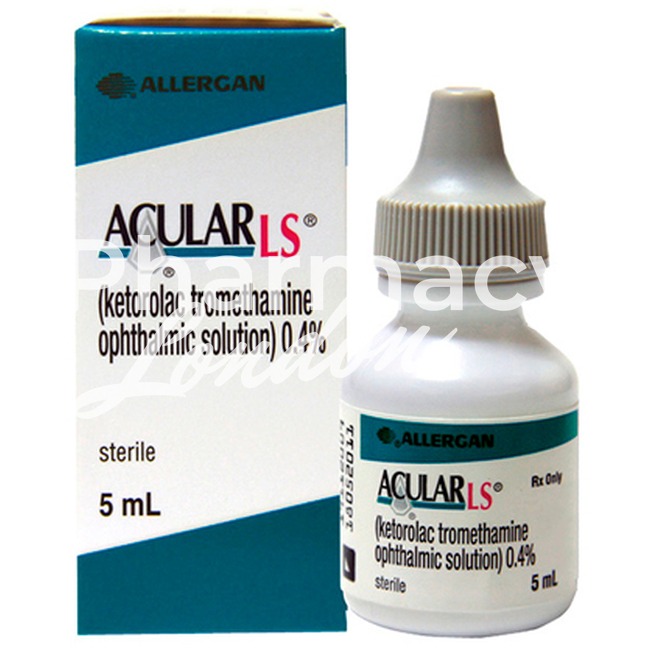
- Acular is offered as ketorolac trometamol 0.4% eye drops, manufactured as Acular LS; each bottle holds 5 ml, with 2, 4 or 6 bottles per pack.
- A prescription-only medicine (POM) in the UK, it belongs in eye care and requires a doctor's treatment decision and supervision.
- The 0.4% Acular LS label concerns pain and burning or stinging after corneal refractive surgery; the labelled course is up to 4 days.
- Do not confuse this offer with UK-licensed Acular 0.5%, or transfer instructions from that different-strength product.
- NSAID or aspirin sensitivity, asthma, bleeding tendency and corneal or healing problems must be discussed before use.
- Urgent medical help is needed for deteriorating sight, increasing or severe eye pain, pronounced redness or a serious allergic reaction.
- Remove contact lenses for administration, space other eye drops at least 5 minutes apart, and discuss pregnancy; late-pregnancy use should be avoided.
- The doctor sets course length regardless of pack size. Delivery time depends on the shipping method and is shown at checkout.
Acular
Essential Details for Acular Eye Drops
- Product supplied: Acular LS, a sterile solution for ocular administration.
- INN and concentration: ketorolac trometamol 0.4%, or 4 mg/ml.
- Pack selection: 2, 4 or 6 bottles, each containing 5 ml.
- Therapeutic family: non-steroidal anti-inflammatory drug (NSAID).
- Shop category: eye care.
- Supply classification: prescription-only medicine (POM) in the UK.
Identify Your Acular Bottle Before Treatment
Under the name Acular we supply ketorolac trometamol 0.4% eye drops (Acular LS). You can select packs of 2, 4 or 6 bottles; the contents of each bottle are 5 ml. This is the manufacturer's Acular LS formulation, and the 0.4% strength should be checked against the prescription before the first application.
There is an important distinction between this offer and UK-licensed Acular, which is 0.5%. Licensing information and treatment schedules for the UK 0.5% preparation do not become instructions for 0.4% Acular LS. The use and dose described on this page refer to the US manufacturer's 0.4% labelling, with prescribing and supervision remaining the doctor's responsibility.
Acular Treatment Starts with the Surgeon
Following corneal refractive surgery, Acular LS is labelled for reducing ocular pain and burning or stinging. Corneal refractive procedures reshape the eye's clear front surface to change focusing. Whether this medicine fits your recovery plan depends on the operation and the findings of the clinician examining your eyes.
Acular is not a treatment to select yourself for unexplained redness, discomfort or an undiagnosed eye problem. Ketorolac trometamol belongs to the NSAIDs and inhibits production of prostaglandins involved in pain and inflammation. It is not an antibiotic or a corticosteroid, so it has a different place in treatment from those medicines.
Planning an Acular Course: Label Information
According to the US Acular LS 0.4% label, the dose is one drop into the operated eye four times daily as needed for pain and burning or stinging, for up to 4 days after corneal refractive surgery. These details explain the official labelling; your doctor decides your actual dose and duration and specifies which eye requires treatment.
Do not borrow a schedule from Acular 0.5%, increase the number of applications, start treatment before surgery or prolong the course without the doctor's direction. A larger pack does not imply a longer course. Any uncertainty about the prescription should be resolved with the prescriber before you change how the medicine is used.
Acular Safety Checks Before the First Drop
- An allergy to the active ingredient or any component of the solution means the medicine must not be used.
- Previous aspirin or NSAID sensitivity needs explicit discussion: cross-sensitivity can occur, and UK Acular information contraindicates treatment in patients with previous sensitivity.
- Asthma must be mentioned, even if it has not recently caused symptoms.
- Report abnormal bleeding and provide details of anticoagulants, antiplatelets and other medicines affecting clotting.
- Tell the surgeon about dry eye, impaired corneal sensation, surface damage, diabetes or rheumatoid arthritis.
- Include complicated operations and several eye procedures performed close together in your history.
Acular and the Risk of a Severe Reaction
Ketorolac eye drops have been linked to bronchospasm and worsening asthma, particularly where asthma or sensitivity to aspirin or NSAIDs is already present. Stop Acular and get urgent medical help if breathing becomes difficult, wheezing develops or the face or throat swells. Do not try a dose to find out whether a known medicine sensitivity will recur.
Careful Handling of Acular at Home
With clean, dry hands, tilt the head backwards and look up. Draw the lower eyelid down gently and place the prescribed drop into the pocket formed beneath it. Keep the nozzle clear of the eyeball, eyelids, eyelashes, skin and fingers, then close the eye gently and recap the bottle.
Acular must only be used in the eye, not swallowed or injected. Keep your bottle to yourself. A contaminated tip can introduce bacteria and cause a serious infection that may harm sight. If the tip has touched a surface or the container is damaged, consult the pharmacist about safe handling.
Separating Acular from Other Drops and Lenses
A minimum gap of 5 minutes is needed between Acular and another eye-drop preparation. The surgical team or pharmacist can set out the application order when several medicines are prescribed. Give them the full list of eye treatments, and do not independently introduce another anti-inflammatory preparation.
Contact lenses must not be worn when administering Acular LS. Benzalkonium chloride is present as a preservative and is relevant to both lens use and irritation. Ask when ordinary lenses can be worn again after your procedure. If your surgeon has fitted a protective bandage lens, obtain specific instructions and leave its removal to their direction.
Acular and Recovery of the Corneal Surface
Healing can be slowed by NSAID eye drops. Acular used alongside steroid eye drops may further increase healing problems, so the combination needs medical oversight. Keeping scheduled postoperative examinations allows the clinician to assess recovery rather than relying solely on the amount of discomfort you notice.
Topical NSAIDs can cause inflammation of the cornea, known as keratitis. In vulnerable eyes they may also cause surface breakdown, erosion, thinning, ulcers or perforation, with potentially sight-threatening consequences. A clinician finding corneal surface breakdown must discontinue the NSAID and arrange close observation.
Dry eye and other surface disease, reduced corneal sensation, existing defects, diabetes and rheumatoid arthritis increase concern. Complicated surgery or repeat operations in a short interval are also risk factors. Your Acular prescriber needs this information before deciding whether and how to treat you.
Acular Precautions for Bleeding
Platelet activity can be affected by NSAIDs, potentially extending bleeding time. Bleeding in eye tissues has been reported with this medicine class around surgery. A known tendency to bleed, or medication that prolongs bleeding, therefore requires assessment before Acular is prescribed.
Do not stop a blood-thinning medicine or any other prescribed treatment yourself. Instead, let the surgeon and relevant prescriber decide how to manage your medicines together. This also applies when the eye prescription includes a corticosteroid.
Acular Reactions: What Needs Medical Attention?
Stinging or burning may follow instillation of ketorolac drops. Reported Acular LS effects also include redness, swelling, eye pain and headache. Some corneal abnormalities need an eye examination to identify them. Discuss irritation that persists or other troublesome symptoms with the team supervising the course.
Urgent Warning Signs While Using Acular
Stop Acular and seek urgent medical help for severe or increasing eye pain, a deterioration in vision, pronounced redness, significant sensitivity to light or a suspected injury to the cornea. New discharge, injury to the eye or symptoms suggesting infection warrant prompt assessment. Increasing the dose is not an appropriate response to these changes.
Brief blurred vision can follow Acular application. Wait for clear sight before driving, cycling or using machinery, and follow the surgeon's wider advice about these activities during recovery.
Acular Decisions in Pregnancy and Breastfeeding
Tell the prescriber about pregnancy, an intended pregnancy or breastfeeding. UK prescribing information does not recommend ketorolac eye drops during pregnancy, and late-pregnancy use should be avoided because NSAIDs may affect the baby's circulation. Low exposure from ocular administration does not remove this precaution.
For breastfeeding, the UK Acular SmPC advises against treatment, whereas the Acular LS label advises caution. A doctor must consider these points when choosing your medicine. Do not restart a previous course from a stored bottle without a fresh treatment decision.
Acular Alongside Comparable Substances
| Class | Substance | Relevant distinction |
|---|---|---|
| NSAIDs | Ketorolac trometamol | Acular LS 0.4% is the offered formulation; its labelled use concerns discomfort after corneal refractive surgery. |
| Bromfenac | Ophthalmic formulations are used for postoperative inflammation according to their own product information. | |
| Nepafenac | An ophthalmic anti-inflammatory option with directions specific to its formulation. | |
| Corticosteroids | Dexamethasone | A different anti-inflammatory family, carrying separate monitoring requirements and precautions. |
The table does not establish equivalent doses or recommend a replacement for Acular. Selection depends on the diagnosis, surgical procedure and examination, and a doctor must authorise any change of substance or formulation.
Acular Storage, Supply and Handling
Manufacturer storage instructions for Acular LS are 15–25°C with protection from light. Secure the cap after use and store the bottle where children cannot reach it. Observe the expiry and handling instructions supplied, and ask the pharmacist to resolve unclear directions. Each pack contains the same 0.4% medicine in 5 ml bottles, whether you select 2, 4 or 6.
Supply must reflect prescription assessment and the doctor's plan. Delivery time depends on the shipping method and is shown at checkout.
Supporting information: [Acular LS prescribing label from the manufacturer](https://www.rxabbvie.com/pdf/acular-ls_pi.pdf) and [UK SmPC for Acular 0.5%](https://www.medicines.org.uk/emc/product/855/smpc). These describe different strengths and should be read accordingly.
Questions Patients Ask About Acular
Will an Acular pack contain different strengths?
No. The offered packs contain only Acular LS 0.4%, with 5 ml per bottle. The available quantities are 2, 4 or 6 bottles.
Can I drive immediately after applying Acular?
Wait if your sight is blurred, and drive only when vision is clear and the surgeon's recovery instructions allow it.
Should I take out a surgical bandage lens for Acular?
Ask the surgical team for specific directions and do not remove a fitted protective lens yourself. Ordinary contact lenses must not be worn during administration.
Who decides whether I should change from Acular?
Your doctor must assess and authorise a change. Another anti-inflammatory drop is not automatically an equivalent substitute.